Incorporating the Simple Living Review, the Preparedness & Self-Reliance Review, as well as the Outdoor & Survival Review

PRODUCT REVIEW - TU 05 "BELT KNIFE"

PRODUCT REVIEW

Toerags Untility Equipment T.R.U.E.
TU 05 "BELT KNIFE"

Toerags LTD
8a Wharfdale Road

Service Rd

Westbourne

Bournemouth

Dorset BH4 9BT

England

Tel: +44 (0)1202 766333


info@toerags.com
www.toerags.com


The term "Belt Knife" for this little 2-inch liner-lock folder with one-hand opening stud on the blade and steel clothing clip may be somewhat of a wrong and exaggerated term but, folks, I did not name it thus, the manufacturers did. The name, obviously, stems from the ideas that the knife would be attached by means of the clothing clip to a belt and worn thus via the clip, I find, being rather strong, works best on clothing, like the watch pocket of a pair of jeans, for instance.

First of I should also say that I did not receive this little blade from the manufacturer for review purposes but, actually, purchased it. This is no big deal really at only £6.99 in a store near my home. I had seen the T.R.U.E. range in their window display for some time and had intended for some time to buy one of those little blades just for the heck of it, so to speak. I am glad I did.

I cannot tell the reader where the blade and knife was actually made as no manufacturing country is given. All it says on the blade is "stainless". However, for the price it is a very well-made little piece of kit. The blade is a Bowie-style hollow ground that take a nice keen edge and it appears to sharpen up best on a steel than anything else. The handles appear to be brushed aluminum with rubber inlays. No rivets have been used throughout instead the blade pivots on a screw rivet that also holds the clothing clip, which means that it can be retightened should this be necessary, and the scales are held on also with small Hex screws recessed into the scales. There is no wobble in the blade and the liner lock holds very solid indeed. Seeing that the slots of the main screw rivet had the marks of a screwdriver having been used I would assume that those knives are actually hand-assembled and checked.

The knife comes in a cardboard "presentation" box with a 10-year warranty and I can only say that I am rather impressed, and I do not impress easily, with this little blade. I am currently putting it thru its paces in using it here and there at work and elsewhere. Already out of the box the edge on the knife was not bad at all but with a little help on a smooth carborundum stone and a an old style steel it got even better.

All-in-all, having now had the occasion to wear and use it regularly I can say that it is a useful little blade and comes in handy for many tasks, especially seeing its one-hand opening facility.

© Veshengro, 2007

PRODUCT REVIEW - LED Lenser V2 Triplex

LED Lenser V2 Triplex - A Product Review

With new light chip technology

Cloverleaf reflector system
3 high quality LED’s, in fact a high intensity LED light chip
Solid metal casing
Durable nylon pouch and lanyard included

Burn Time: Up to 10 hours from 1 AA alkaline battery.

Dimensions: 141mm x 37mm
Weight: 160gms
Power Supply: 1 x AA alkaline battery (Two sets of batteries included: 2 x AA)

The patented pure metal housing is ergonomic and extraordinarily smooth to the touch. The patented photon tube reflectors cause the high power diodes to shine with undreamed of brightness. Due to its low power consumption, 1
x AA alkaline battery will provide up to 10 hours of light.

Price: approx. GBP 24.99
Agents in the UK: Ledco Ltd. www.ledco.co.uk

Manufacturers: Zweibrüder Optoelectronics GmbH www.zweibrueder.com

Well, so much for the information from the manufacturer and UK distributor. However, I must say that I am most impressed, as as I have mentioned before on occasions, I do not impress easily, with the design and especially the light output from this little light. It is about the size of the so-called “Mini Maglite”, the one that uses 2xAA batteries as power source, but that is about where the comparison ends. The power source in this one that I have tested and am using is one single AA alkaline cell and considering that, the light output is awesome and then some more.

The light source is a three LED light chip in a cloverleaf pattern (see picture) and the
diodes produce an extremely bright and intense white light.

As far as I understand this version of the flashlight is also available in Mossy OakTM camouflage.

The only drawback that could be mentioned is that the beam cannot be focused but, then again, there are others of the same manufacturer where this is indeed possible and I do hope to be able to review – should the manufacturer/agents be prepared to furnish me with the samples for review – some of their tactical flashlights, including the new one that is aimed at the law enforcement market. I have seen it and handled it already but have not been able to put it thru its paces properly, not having a review sample to hand.

All I can say is that this surely is a lot of light in a small package and don't let the price deter you. This is a solid little flashlight made of solid stuff and I am sure it will give
many, many years of reliable service.

Reviewed by Michael Veshengro Smith ©

BOOK REVIEW - Lighting Grandma’s Fire

“Lighting Grandma’s Fire”
Mountain Skills and Valley Pastimes

By Bill Cunningham

Western Reflections Inc.
P.O. Box 710
OURAY, CO 81427
Tel.: 970/325-4490
Fax: 970/325-0782

ISBN 1-890437-33-6
152 pages paperback, many illustrations.
Price $ 11.95 + s&h
Obtain directly from publishers or at local bookstore.

If you have ever wanted to learn how to make a pair (or more than just one) of Indian moccasins, learn how to cook in a Dutch oven or how to make a pair of snowshoes then this book by Bill Cunningham could be your guide and first stop. These and a number of other skills and crafts are explained and described in the book including of “How To Light Grandma’s Fire” – the old-fashioned way, without matches or lighters. The book indeed has some nice projects in it and gives also food for thought for further ones.

One thing, however, I do have to mention as the reviewer – if I wouldn’t I would do a great disservice to my readers – and that is the unfortunate fact that yet another non-expert gives “advice” on the sharpening of knives as on pages 53-59. This “advice” is bordering on the dangerous. Whetstones should never be used dry. The author, however, recommends, indeed urges, just that. He states that “oil and water both clog the pores of the stones”. I beg to differ and I have been sharpening knives professionally as well as making them since I was six years old.

Oil or water (and I recommend water over oil) on a sharpening stone prevents clogging of the stone’s pores with grit and metal debris and not the opposite. I personally recommend the use of water instead of oil – as some stones don’t like oil – and to regularly flush the stone with water (always have at hand plenty of water while sharpening knives).

Furthermore, the grind angle that the author recommends is far too steep; a flatter one of 10-15º is what is needed; 20º is already far too steep and reaching an angle that is used for sharpening hatchets. I do, in actual fact, sharpen my hawks and hatchets at an angle of 20º. Advice on the use of wet & dry silicon carbide sandpaper (a.k.a. emery cloth/paper) – ouch! Now that hurts. Emery paper of the various grits may glued to individual boards may indeed make great knife hones but do not use like a stone in that you move the blade across the stone as if trying to cut a slice from it. Instead use like leather razor strop with the same movements of the blade across same, e.g. pulling away from you.

I do honestly wish that writers with no or little experience would stop trying to give “advice” on subjects that they are not masters in and leave the giving of advice on knife sharpening to those of us whose trade are knives and the sharpening of same, e.g. to the cutlers amongst us.
This one short chapter of – dare I say it – garbage, spoils the enjoyment of the complete book. Please people write about the things that you really know about and not about things that you know little of. I am sorry that I did have to say this but I do believe that the readers of this newsletter deserve to know the truth.

“LIGHTING GRANDMA’S FIRE” is a nice book with nice projects and it is a shame that this one chapter, for me at least, spoiled it. I would have also appreciated a more extensive bibliography as regards to Mountain Men skills and such.

M V Smith, 2007

BOOK REVIEW - SLEEP CLOSE TO THE FIRE

SLEEP CLOSE TO THE FIRE
By Jim Allen

Trailhead Press
P.O. Box 4717
ELKHART, IN 46514-0717

128 pages softback, $12.95

The Best way to get to know the lay of the land is to climb a high hill and look around. This is known as perspective. Life’s perspectives only come to those with age and experience. In his book “Sleep Close By The Fire”, Jim Allen shares 20 years of experience as a hunter, trapper, fisherman, naturalist & wilderness skill instructor. Thru stories, poems, “How-To” articles, and humor, the author touches something deep within the heart of every outdoorsman: that desire to connect with Nature.

“Sleep Close By The Fire” is indeed a book with lots of common sense advise for backwoodsmen young and old alike; often quite hilariously written – I sure did have a good laugh at a number of places in the book.

The book, as far as I understand it, is an anthology, a collection of stories and articles that have previously appeared in the Backwoodsman Magazine, and other publications.

I especially liked the place where the author talked about how important it is for kids to be “gainfully employed in feeding the family” and how much this will increase their self-esteem. Jim is so very right there. I can vouch for that as I, as a six-year-old boy began earning money sharpening cutting tools such as knives and thereby helping to feed the family by earning money as well as by hunting and foraging to put food on the table. Being able to do that and being expected to do that made us little ones feel so important indeed.

I can recommend this book to anyone looking for a common sense book to read from which also to get some guidance and hints here and there.

© M V Smith, 2007

Buying Used Clothing

Why and How to Buy Used Clothing

A lot of frugal folks won't think twice about buying used clothing, from garage sales to thrift stores, but there are some who wouldn't dream of wearing 'somebody else's old clothes'.

There are two reasons people don't want to buy used. One is pride, often known as conceit, as in 'I'm too good to wear used clothing!' These people often have an awesome array of credit cards, and as often, not much real money.

The other is squeamishness. 'Eww... wear something that once belonged to someone I don't even know?? What if they had some awful disease...' These people also take their own sheets and towels when they travel, not wanting to use those from the motel that someone else has used before. They never rent skates, either.

The best reason for buying used clothing is often our budgets, but that isn't the only reason. Most of us are not in such bad shape that we can't afford to buy something new now and then. It just doesn't make sense to - not when you can buy three or four somethings 'newish' with the same money and have a better choice!

It's not at all like shopping at a retail store, with it's racks of same style clothing in limited colors and often in limited sizes. At a second hand store, there's not much telling what you can find! People who are unusual sizes often go to big cities to shop or shop from specialty (read 'expensive') catalogs, then sell or give away their old clothing. People with lots of money (or those who just pretend to have lots of money) often buy clothing from several sources and discard 'old' clothing on a regular basis. You can be the benefit of that.

Don't go with a specific style and color in mind, but do go with a list of what you need. Look ahead, too, and be alert to good buys on things you'll need in the future - children's next-size clothing or seasonal furnishings, perhaps maternity clothing or baby items.

Write down clothing and shoe sizes for everyone in your family as well as color and style preferences. Be specific as to what they need. It's not frugal to buy a third white shirt for your little boy, especially if he only wears one a couple of times a year.

You may not find exactly what you're looking for the first time you go to a thrift store or hit the garage sales, but you will eventually. To get the most out of second hand shopping, you need to go often, but you don't buy anything at all if you don't see what you're looking for. You won't save any money if you buy a sackful of junk and things you don't need every time you go, but you won't save either, if you miss that perfect dress or baby outfit because you weren't there.

If you go used clothing shopping at a garage sale especially, wear snugly fitting clothing so you can slip a shirt on to check the sizes or wrap a skirt around your waist to see if it fits.

Zero in on the garage sales most likely to have what you want. A garage sale in a retirement community is highly unlikely to have children's clothing or toys and a community filled with scooters and basketball hoops very likely won't be selling Grandma's handkerchiefs with tatted edgings.

Pay attention to details, whether you shop at garage sales or in a second hand store. Zippers, buttons, tears, ripped seams and pockets and stains may not stop you from buying the item, but the seller should adjust the price for these problems. Many of them can be fixed easily, but be aware of them before you buy and decide whether you want to fix them or not.

Keep an eye out for the occasional sale at a thrift store. That's the time to find material for that quilt you want to make, or the rag rug, or to make other clothing from. It's the time to stock up on undershirts for cold weather (they don't have to be plain white!) and anything else you might need.

Most garage sales are held near the end of the week and/or over the weekend, but it's best to shop the thrift stores during the week. Weekend crowds in the local Salvation Army or Goodwill store can be pretty heavy and make it hard to look through everything.
Consider the time you spend shopping this way to be an investment. One or two trips, or one or two stores or garage sales, won't necessarily have the things you're looking for, but the merchandise changes constantly. Every other week is a good schedule for thrift store shopping and a tight fist is the best policy.

Be sure of the quality of the item and your need for it and you'll win, every time.

Most, if not indeed all of my clothes, with the exception of my uniform, socks and underwear, are bought at Charity Shops, Goodwill Stores, Car Boot Sales, Garage Sales, and the like. $85 boots for $8, a $110 Australian Outback collection jacket for $15, and $65 Bush hat for $2 and so on…

I shall be talking about "thrift shopping", incl. "roadside shopping" in future post on this publication.

© M. V. Smith, March 2006

Product Review - LED Lenser V8 Turbo


LED Lenser (Photon pump) V8 Turbo


Product Details:

Crystal reflector tube system. LED Lensers reflector tubes are lined with Italian crystal and precisely shaped to "pump up" the light produced by the LED for a broader, more powerful beam.
High intensity light chip.
24-carat gold contacts - gold is a superior electrical conductor, which minimizes energy lost at the contact points and maximizes energy that goes into light production.
Solid metal casings - most competitors have plastic.
High Wattage LEDs - LED Lenser uses only the highest wattage and the finest quality LEDs. We laboratory test our lights to determine precise milliwatt output.
Batteries included 4 x AG13.
Length: 7cm.
Weight: 38 grams
Lifetime guarantee.

Price: approx. GBP 9.99
Agents in the UK: Ledco Ltd. www.ledco.co.uk

Manufacturers: Zweibrüder Optoelectronics GmbH www.zweibrueder.com

The "Photon pump" V8 Turbo is a small but extremely powerful miniature flashlight of the LED Lenser Optoelectronics range. Seeing that my own example was not a sample but was given to me as a FREE gift at a tool and DIY exhibition for attending I was, obviously, wondering as to what quality this would indeed be, as, let's admit it, most advertising gifts are not necessarily quality and I must say that I am extremely surprised. Obviously the little light is the standard product with the exception that, in my case, it bears the logo of the exhibitions it was to commemorate.

The light of the flashlight is to powerful that the warning not to look directly into the light is something that should definitely be heeded. I did not heed it and I had problems with my vision for a while after. Self-inflicted injury for sure and as the warnings were clearly visible on the package I had no one to blame for it by my own stupidity. According to the "fact sheet" the light is visible for 2,000 meters and though not having tested it I do not doubt it in the least as indoors and out it outshines a seven-LED flashlight of mine.

The body - small as it is - is of solid metal, is galvanized, so it appears, and I must say that I was rather surprised as to the weight of this little device.

Featured in the Frankfurt Museum for modern Art and a winner of two prestigious design plus awards, the V8 turbo is a design classic. Shook proof and water resistant. The innovative LED light chip lasts for up to 100,000 hours making this the ultimate key ring accessory.

If all of the flashlights produced by Zweibrüder Optoelectronics in Germany, who are behind LED Lenser, are of the same quality as this little light that was given to me by a representative of the British agents at the show mentioned then one cannot go wrong investing in one or more of their flashlights.

This small little light designed, theoretically, to be carried as a key ring attachment, really packs an unbelievable punch as regards to brightness and distance of beam and does make an ideal small light to add to anyone's survival kits and such. The only disadvantage, I guess, is the fact that the batteries are not one of the common garden variety but rather button batteries of the type mentioned in the specifications. However, the little unit given to me not only came fitted with a set of batteries but had a spare set included in the blister pack as well. That should at least provide somewhere in the region of 500 hours of light.

Reviewed by Michael Veshengro Smith ©

Household Hints


Cider vinegar can be used for a lot more than salad dressing. It has excellent health and cosmetic benefits.

Pour a quart of boiling water over a cup (packed tightly) of Stinging Nettles and let steep until cool. Strain, and add a cup of cider vinegar. Use this as a final rinse after shampooing to remove soap scum and impart a sheen to your hair.

Simmering hardened paintbrushes in boiling vinegar for a few minutes, then washing them in soapy water should make them like new again.

Next time you have to do some work outside on a cold day, rinse your hands in vinegar and let it dry. The cold will not affect your hands as much.

When lime has built up in your teakettle, boiling a weak solution of water and vinegar for a few minutes should loosen it up.

A little vinegar in the water when you boil eggs will keep the whites in a cracked shell.

To make paint stick to a galvanized surface, wipe over it with a rag dipped in vinegar.

When storing water jugs, put a tablespoon of cider vinegar in each one and it will eliminate the musty smell.

A couple of spoons full of vinegar in a quart of water will clean your windows without leaving streaks.

A tablespoon each of cider vinegar and raw honey in a cup of hot water will soothe a sore throat.

If the cane seats on your chairs have sagged, rejuvenate them by sponging them with half water half vinegar and set them in the sun to dry.

A spoonful of cider vinegar in a glass of water is supposed to repel ticks, if you drink it every day.

A ¼ cup of cider vinegar mixed into an older horse's feed every day will ease the stiffness in its joints. (Wonder whether that would work for humans too… Ed.)

Cider vinegar is an excellent disinfectant for cuts and scrapes. Stings like sixty tho.

When cutting up fruit such as pears and apples, putting them into a weak solution of cider vinegar will keep them from turning brown.

Owen Newman

How to Sharpen an Axe or Hatchet


Axes have a much thinner profile than splitting mauls and mattocks. After years of sharpening, they tend to be thicker at the tip than when they were new creating more of wedge effect than a slicing action. This can be overcome by filing back material further on the blade. In other words, don't continually file just the tip of the blade but reduce the thickness of the head back one-half inch with each filing. To be sure you know how much to take off, refresh your memory by taking a look at a brand new head before starting to sharpen your old one.

Building A Composting Toilet


The modern flush toilet is very wasteful of water. The alternative, of course, is a way to dispose of human waste that does not use up resources.

There are many models on the market that do not use water such as chemical (very smelly and messy), or burning it by means of gas or electric which means being dependent on the grid, or having big holding tanks under your house. The one resource that all of these systems use is great amounts of your hard earned money.

We have a composting toilet that did not take a lot of money, nor uses water, chemicals, or heat. It is simply a box and a bucket.

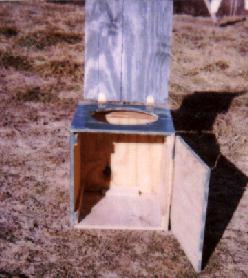
I built a box to hold a five gallon plastic bucket out of ½" plywood. It is 15"w x 16"d x 16"h. The front panel is hinged to make a door. I made a lid out of the same material and hinged it at the back. After cutting a hole alá an outhouse, I painted it with some gloss enamel paint so it would be easy to clean.

"Surely" you say, "You don't use it in the house?" Yep, sure do. "What about the smell? Doesn't it attract flies?" Nope! The secret to this system is rotten sawdust. After every use, you sprinkle enough sawdust to cover the deposit. When the bucket is full, you empty it place where it's out of the way and cover with more sawdust. The bucket is washed out, a layer of sawdust sprinkled in to thinly cover the bottom and placed back in the box.

We've been using this system for a year and the pile is about 4' long by 2' wide by 2' high. This spring we will start a second pile and let the first one compost for a year. By that time it will have heated up enough to kill any pathogens and broken down into rich black compost that is safe to use in your garden or around fruit trees.

I learned about this system from The Humanure Handbook, which can be ordered from Lehman Hardware, Kidron, Ohio. I suggest that you get a copy of the book. It's informative and well written with a sense of humor.

We have never had a problem with odor or flies, not even tile composting pile seems to attract flies. The rotten sawdust must have something in it that repels insects that usually are attracted to rotting organic matter.

Owen Newman